Archaeological Time Periods and Abbreviations.
----------------------------------------------------------------
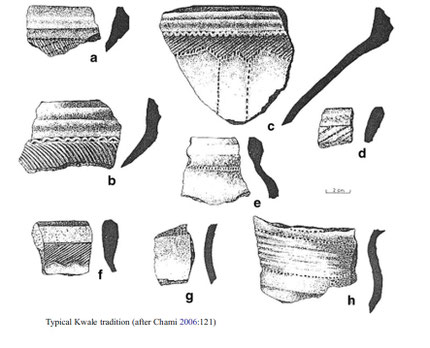
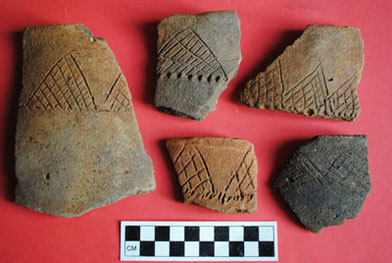
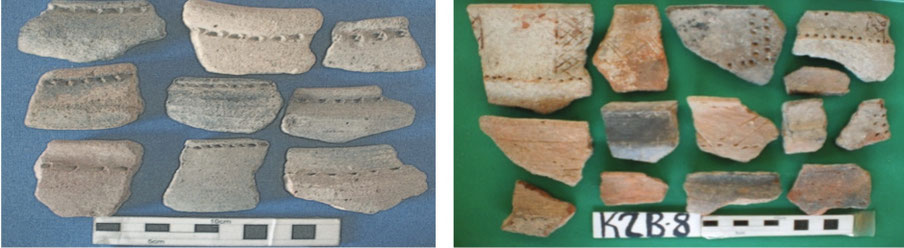
|
Taken out: The Archaeology of Tanzanian Coastal Landscapes in the 6th to 15th Centuries AD E.J.D. Pollard 2008 |
||||||||
|
Century |
Chittick (1974) |
Horton (1996) |
Chami (1999) |
Mapunda (2002) |
Kusimba (1999) |
|||
|
2nd BC |
|
|
Early Iron Ware (EIW) |
Limbo |
Early Iron Working (EIW) |
|
|
|
|
1st Bc |
|
|
Period I: Earliest iron working settlements |
|||||
|
1st AD |
|
|
||||||
|
2nd AD |
|
Kwale Ware |
||||||
|
3rd AD |
|
|||||||
|
4th AD |
|
Kwale |
Period II |
Azanian |
||||
|
5th AD |
|
|||||||
|
6th AD |
|
|
Mwangia |
Middle Iron Working (MIW) |
||||
|
Triangular Incised Ware (TIW) |
||||||||
|
7th AD |
|
|
Zanjian |
|||||
|
8th AD |
|
Tana Tradition: Ceramic Phase A |
||||||
|
9th AD |
Perriod Ia |
|||||||
|
10th AD |
Tana Tradition: Ceramic Phase B |
Plain Ware (PW) |
||||||
|
11th AD |
Period Ib |
Period III: Coastal city building |
||||||
|
12th AD |
Tana Tradition: Ceramic Phase C |
|||||||
|
13th AD |
Period II |
Neck Punctuating or Swahili Ware (NP/SW) |
||||||
|
14th AD |
Period IIIa |
Ceramic Phase D |
||||||
|
15th AD |
Period IIIb |
|
||||||
|
16th AD |
Period IV |
|
Post Swahili (PS) |
Later Iron Working (LIW) |
Period IV: Colonial |
Portuguese |
||
|
17th AD |
|
|||||||
|
18th AD |
Period V |
|
||||||
|
Omani Arabs |
||||||||
|
19th AD |
|
|
||||||
|
Germany & Britain |
||||||||
|
20th AD |
|
|
|
|
|
|||
Data for Imported Ceramics from Different Sources.
--------------------------------------------------------------------------------
Periods of Manda Ceramic Datation
I Sassanoislamique 850-1000
IIa Sgraffiato hachure 1050-1190
IIb Celadon 1190-1290
III Black and Yellow 1290-1400
IV Monochrome 1400-1500
V Manganese violet 1550-1650
VI Porcelain tardive 1650 and +
Turquoise Alkaline-Glazed Ware 9th -10th centuries
Sasanian blue-green glazed ware c. 8 C. AD. Mgombani
Chinese Yue Stoneware c. 9t'-12th C. AD. Mteza
Hatched Sgraffiato c. 11th C. AD. Mteza
Chinese white porcelain c. I1th C. AD. onwards Mbuyuni
Near Eastern Gudulia (water jars) c. 11t'-14th C. AD. Mbuyuni
Islamic greenish blue monochrome c. mid 14t'-17th C. AD. Mbuyuni
Islamic green monochrome c. mid 14''-17`h C. AD. Mbuyuni
Sgraffiato, manufactured widely in the Middle East from the 10th to 13th century and decorated by designs incised through the slip before glazing (Chittick 1970: 65).
Black on Yellow ware from Aden which reached East Africa between 1250 and 1350 (Kirkman, 1966: 26; Horton and Middleton, 2000: 81)
Glossy green and blue monochrome over a red body.
Polychrome ware with a conventional floral design in blue on white on a buff body (Kirkman, 1966: 31-2).
Porcelain named Celadon which came from SE Asia in the late 14th to 15th century (Kirkman, 1966: 26-7).
Blue on white porcelain from the 14th century.
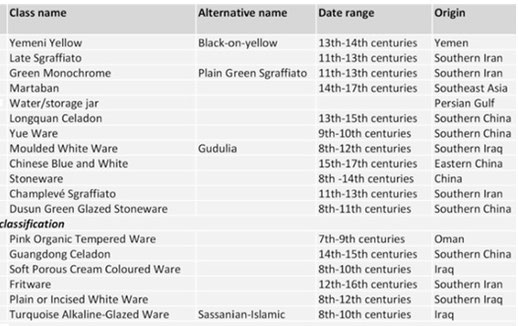
Yemeni Yellow (Black on Yellow) 13th-14th centuries Yemen
Late Sgraffiato 11th-13th centuries Southern Iran
Green Monochrome Sgraffiato
11th-13th centuries Southern Iran
Longquan Celadon
13th-15th centuries Southern China
Chinese Blue and White 15th-17th centuries Eastern
China
Stoneware-storage 8th -14th centuries China
Champlevé Sgraffiato 11th-13th centuries Southern Iran
Monochrome Islamic ware (c. fifteenth century).
Far Eastern green-glazed wares, made in south China: Longqan celadon. These appear in shipwrecks of the twelfth century, and similar wares are made even in the present day. However, on the East Afkican coast they do not appear at Kilwa (Chittick 1974) and Manda (Chittick 1984,70) until about AD 1300.
At Kilwa, Longqan ware is replaced by South-east Asian non-porcelanous green-glazed wares between 1500 and 1550 AD (Chittick 1974, 311).
Green-glazed wares of any type are rare in the well-dated sequence of Fort Jesus at Mombasa, which was built in the 1590s (Kirkman 1974: 107, pl 32.6), though Far Eastern blue-and-white porcelain is common.
- Kenyan archeologist Kiriama argues that the porcelains from China to Kenya has several peaks, while the first peak appeared at 9 th-10th century and the exported shards of Yue ware, Changsha ware, Canton Celadon and Northern white ware were found in Lamu Archipelago.
- Kenyan archeologist Herman Kiriama termed the second half of 13th century to the beginning of 15th century as the “Second Peak” of Chinese porcelains to Africa. During this time, Longquan wares, Jingdezhen Qingbai wares, Fujian celadon and Qingbai wares, and blue and white, copper red wares from Jingdezhen were all found in coast of Kenya. Besides, Changsha wares were found in Shanga, celadon shards produced in Guangdong found in Shanga and a Fanchang ware made in the 10th century was discovered in Manda.
- According to Kiriama, in the 14th and 15th centuries, Chinese celadon was the most popular ware exported to Kenya, its plain glazes ranging through shades of greens and greys to pure dark green. Celadon was more valued because of the belief that it would reveal the presence of poison by cracking. From the 14th century, blue and white porcelain started to appear in East Africa.
- Recent work in Mambrui of Kenya by China-Kenya archaeologists headed by Qin Dashu and Herman Kiriama has unearthed large Longquan green-glazed stoneware dishes of a quality equal to those sent to the Chinese imperial court in the late 14th and early 15th centuries.
Abbreviations
-----------------
Ang.: Angular
BIEA: British Institute in Eastern Africa
EDM: Electronic Distance Measuring
EIA: Early Iron Age = EIW: Early Iron Working (EIW)
EIW: replaced the EIA term with Early Iron Working (EIW)
EIW: Early Iron Ware
ETT: Early Tana Tradition= Triangular Incised Ware
HWM: High Water Mark
IA: iron age
LIA: later iron age
LIW: Later Iron Working
LP: Line of punctuation
LSA: Late Stone Age
LWM: Low Water Mark
MIA: Middle Iron Age
MIW: Middle Iron Working
MSA: Middle stone age
MWL: Mean Water Level
N: Neolithic
NP: Neck Punctuated (NP) ware = Swahili Ware (SW)
PN: Pastoral Neolithic
PS: Post Swahili
PW: Plain Ware
Roun.: Rounded
SG: dating historical mortar through Optically Stimulated Luminescence using the « Single Grain technique » (SG-OSL) into archaeological research.
SMA: Stone to Metal Age
Subang.: Subangular
Subrou.: Subrounded
SW: Swahili Ware = Neck Punctuated (NP) Ware
TIW: =triangular incised ware
TP: Test Pit
TT: Tana tradition = early kitchen ware = TIW=triangular incised ware= Wenje ware.